
Does a Native HVAC Protocol Really Mean a More Reliable Integration?
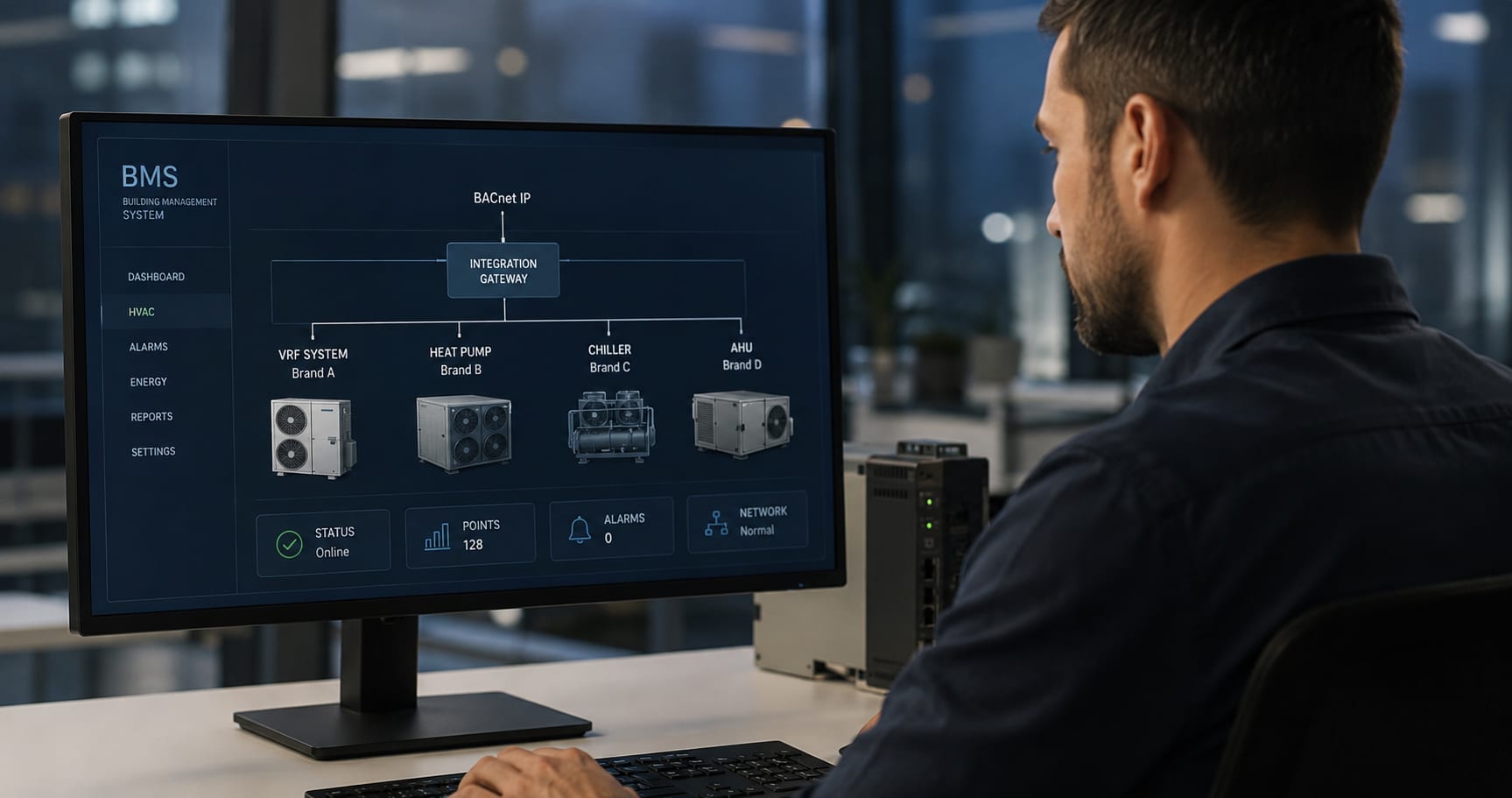
Why “Native Protocol” Should Not Be the End of the Reliability Conversation
In HVAC integration, few words sound as reassuring as “native protocol.” For a system integrator, the idea is easy to understand. If an integration solution communicates directly with HVAC equipment using the manufacturer’s own communication protocol, it should be more reliable than a solution that has had to reverse-engineer that communication. It is a logical argument, and in some situations, access to the native protocol can certainly be a significant advantage.
But there is a problem when this argument goes one step further when native protocol access is presented as evidence of reliability in itself. That is a much bigger claim. A reliable HVAC integration is the result of many factors: protocol implementation, hardware, software, testing, compatibility management, commissioning, diagnostics, firmware updates, cybersecurity, and long-term support. The protocol is important, but it is not the whole story.
What Does “Native Protocol” Actually Tell Us?
HVAC manufacturers use proprietary communication methods for good reasons. Modern VRF, VRV, heat pump and inverter systems are sophisticated pieces of equipment, and the communication between the controller and the HVAC system can include far more information than simple on/off commands. Temperature setpoints, operating modes, fan speeds, alarms, operating states and other parameters may all need to be exchanged between the HVAC equipment and the external control system.
Working with the manufacturer’s native protocol can therefore provide an integration developer with detailed knowledge of how that equipment communicates. That is valuable. But it tells us something about how the integration was developed. It does not necessarily tell us how the finished integration will behave over the next five, ten or fifteen years. And for a BMS integrator, that distinction matters.
Reliability Is a Lifecycle Issue
Imagine that a gateway works perfectly when it is installed. The project is commissioned, the BMS communicates with the HVAC system, and everything is working as expected. Three years later, however, the HVAC manufacturer introduces a new controller, changes a firmware version, or releases a new generation of indoor units. At that point, the question is no longer whether the integration vendor originally had access to the native protocol. The question is whether the vendor has maintained the integration.
This is one of the most important aspects of HVAC integration that can get lost in discussions about protocol access. Reliability has to be maintained. An integration platform needs an ongoing process for testing new equipment, identifying compatibility issues, updating software and supporting equipment already installed in the field. A direct relationship with an HVAC manufacturer can help with this process, but the relationship itself does not guarantee the outcome.
The HVAC Equipment Doesn’t Stand Still
HVAC manufacturers continuously develop their product lines. New models appear, controllers evolve, firmware changes and product families are replaced. For an integration company, this creates a permanent maintenance challenge. A gateway that supports 100 HVAC models today needs to continue supporting those models after the HVAC manufacturers make changes to their products.
This is where the quality of the integration company becomes particularly important. How quickly does it react to changes? How extensively does it test? How does it handle firmware differences? How easy is it to update an existing installation? Can an integrator identify compatibility problems before they become a service call? These are all reliability questions, and none of them can be answered simply by saying that the gateway uses a native protocol.
Reverse Engineering Is Not Automatically Unreliable
Reverse engineering is often presented as the alternative to working directly with an OEM. The implication is straightforward: if the protocol wasn’t provided by the manufacturer, the developer is working with incomplete information, and therefore the integration is inherently less reliable.
That conclusion is too broad. Poor reverse engineering can certainly result in poor products. If a developer makes assumptions about how a proprietary protocol works, fails to test edge cases or does not understand how different generations of equipment behave, the resulting integration can be problematic. But that is an argument about engineering quality, not about reverse engineering itself.
A communication protocol can be studied, tested and validated extensively. And an officially documented protocol can still be implemented incorrectly. The real question for an integrator should therefore be how well the integration has been engineered, tested and maintained not simply where the protocol information came from.
The Industry Itself Shows That There Is More Than One Approach
This is not simply a theoretical discussion. Different companies in the HVAC integration market emphasize different approaches to solving the same problem. Intesis, for example, explicitly highlights direct partnerships with manufacturers and access to native protocols as an important part of its approach to professional building automation. Airzone also emphasizes manufacturer-specific communication and describes its solutions as using manufacturer-native protocols to connect HVAC equipment with home automation and BMS platforms. Loxone similarly highlights native integration with HVAC manufacturers as part of its approach to connecting climate systems with building automation.
The interesting point is not which company uses the better terminology. It is that native communication has become an important selling point across the industry. That makes sense, but it also means buyers should look beyond the terminology and examine what the integration actually delivers in the field.
Native Does Not Mean Future-Proof
One of the easiest assumptions to make is that a native integration is automatically more future-proof. It isn’t necessarily. Future-proofing depends on how the integration is maintained and how easily it can adapt to changes.
Consider a building with several HVAC systems from different generations. The integration may initially work perfectly. Then one manufacturer releases a new product family, another changes its controller, and a third introduces a firmware update. The building now has a mixture of old and new equipment, and the integration platform has to deal with all of it.
This is where software architecture, compatibility management and ongoing development become just as important as the original protocol implementation. A native protocol can give the developer a strong starting point. It does not eliminate the need for continuous engineering.
The Gateway Itself Matters
There is another part of the reliability discussion that is often overlooked. The gateway is a product. It has hardware, firmware, power requirements, network connectivity and software. It can fail, lose communication, encounter a firmware problem or simply be incorrectly configured. None of these problems disappear because the gateway communicates with the HVAC system using a native protocol.
This is particularly relevant in commercial buildings. When an HVAC gateway becomes the bridge between critical HVAC equipment and the BMS, the gateway itself becomes part of the building’s operational infrastructure. The integrator therefore needs to consider recovery after a power failure, communication monitoring, diagnostics, configuration backup and replacement procedures. These are practical reliability considerations that often matter more to the person maintaining the building than the marketing story behind the protocol.
Cybersecurity Is Bigger Than Protocol Provenance
The same principle applies to cybersecurity. Using a manufacturer’s native protocol does not automatically make a gateway secure. Security depends on the entire product architecture, including firmware, network interfaces, authentication, remote access, update mechanisms and cloud infrastructure where applicable.
A gateway using an official protocol can still contain a vulnerability. Likewise, the fact that a protocol has been reverse-engineered does not automatically mean that the resulting product is insecure. The right question is not whether the protocol is “official.” The right question is how the complete product has been designed, secured, monitored and maintained.
For modern BMS installations, this distinction is increasingly important as HVAC equipment becomes more connected to building networks and remote management systems.
What Integrators Should Really Be Asking
For a system integrator, the most useful evaluation criteria are fairly practical. How broad is the actual compatibility, including specific models and generations? How is compatibility maintained when an HVAC manufacturer changes its hardware or firmware? How much work is required during commissioning? What happens when something goes wrong, and can the integrator quickly identify whether the problem is with the HVAC equipment, gateway, network or BMS?
Just as importantly, what happens five years from now? Is the vendor still supporting the hardware and software? If a gateway fails, can the integrator restore the configuration quickly? These questions tell us much more about reliability than the words “native protocol.”
Reliability Should Be Measured by Results
There is nothing wrong with an HVAC integration company promoting its OEM relationships. In fact, strong relationships with equipment manufacturers can be a meaningful competitive advantage. Access to technical documentation can help, access to engineering teams can help, early information about new products can help, and testing with manufacturers can help.
But ultimately, integrators don’t install relationships. They install products. Those products have to work.
The real measure of reliability is what happens in the field. Does the integration remain stable? Does it provide the required data points? Does it maintain compatibility across equipment generations? Is commissioning straightforward? Can problems be diagnosed quickly? Can the vendor support the installation years after it was commissioned?
Those are the questions that should determine whether an HVAC integration platform deserves to be called reliable.
The Native Protocol Is a Starting Point, Not a Guarantee
Native protocol access is undoubtedly valuable. It can give an integration company a better understanding of the HVAC equipment and provide a strong foundation for developing a robust gateway. But it should be treated as one element of reliability, rather than a definition of reliability.
A more complete way to look at the equation is simple: Reliability = Protocol + Engineering + Testing + Compatibility + Diagnostics + Maintenance + Support.
That is particularly true in BMS projects, where HVAC integration is expected to operate continuously and often becomes part of a much larger building automation architecture.
The Bottom Line
The HVAC integration industry has understandably embraced “native protocol” as a strong selling point, and there are good reasons for that. But professional integrators should resist turning a technical characteristic into a complete definition of product reliability.
A native protocol can be an advantage. An OEM relationship can be an advantage. Neither one, on its own, guarantees that an integration will remain reliable throughout the life of a building.
The better question is not simply how the integration was created. The better question is how well it performs, how well it is maintained, and how confidently an integrator can support it years after installation.
That is where true reliability is ultimately decided.